Engineer. Problem-Solver. Builder.

I'm Maxwell Tobin, a rising senior at Duke University from Franklin, MA, studying Electrical & Computer Engineering with a minor in Financial Economics. I chose that combination to understand both the technologies shaping the modern economy, from energy infrastructure to AI-enabled systems, and the strategic decisions that determine which of them succeed. More than anything, I'm passionate about working alongside others to solve the hard problems shaping the next generation.

MT
HEADSHOT — add images/headshot.jpg
Maxwell Tobin

Projects

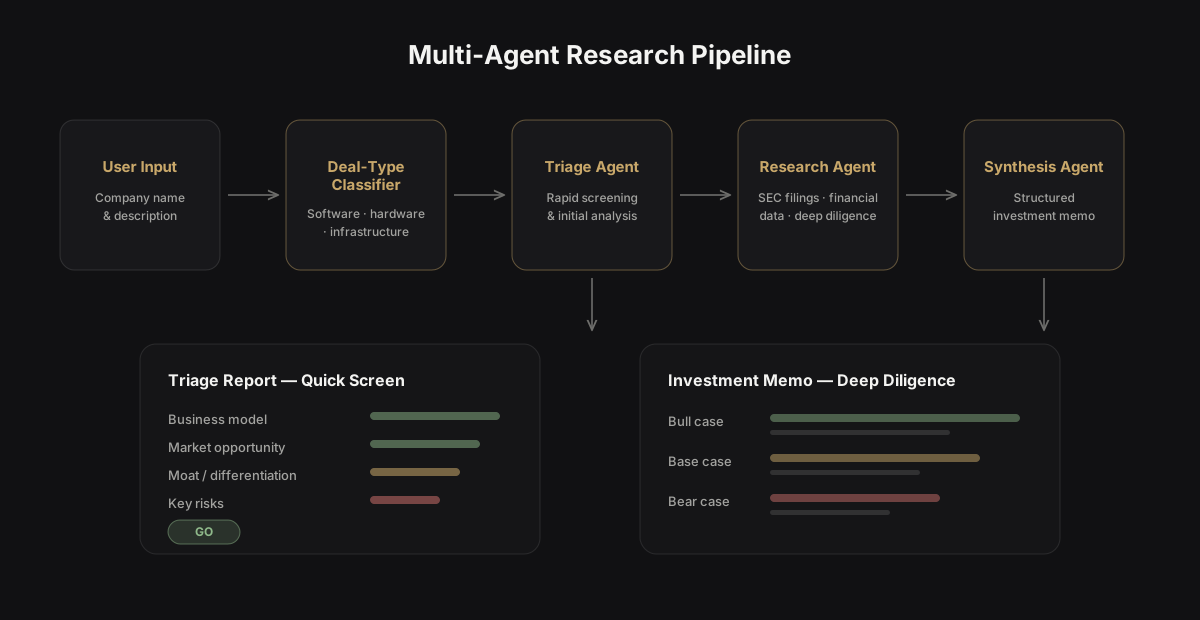
Multi-agent AI research pipeline diagram
Apr 2026 — Present

AI-Powered Investment Research Platform

A multi-agent AI system that automates early-stage deal screening and investment memo writing, with a focus on energy transition investing.
AIInvestingSoftware
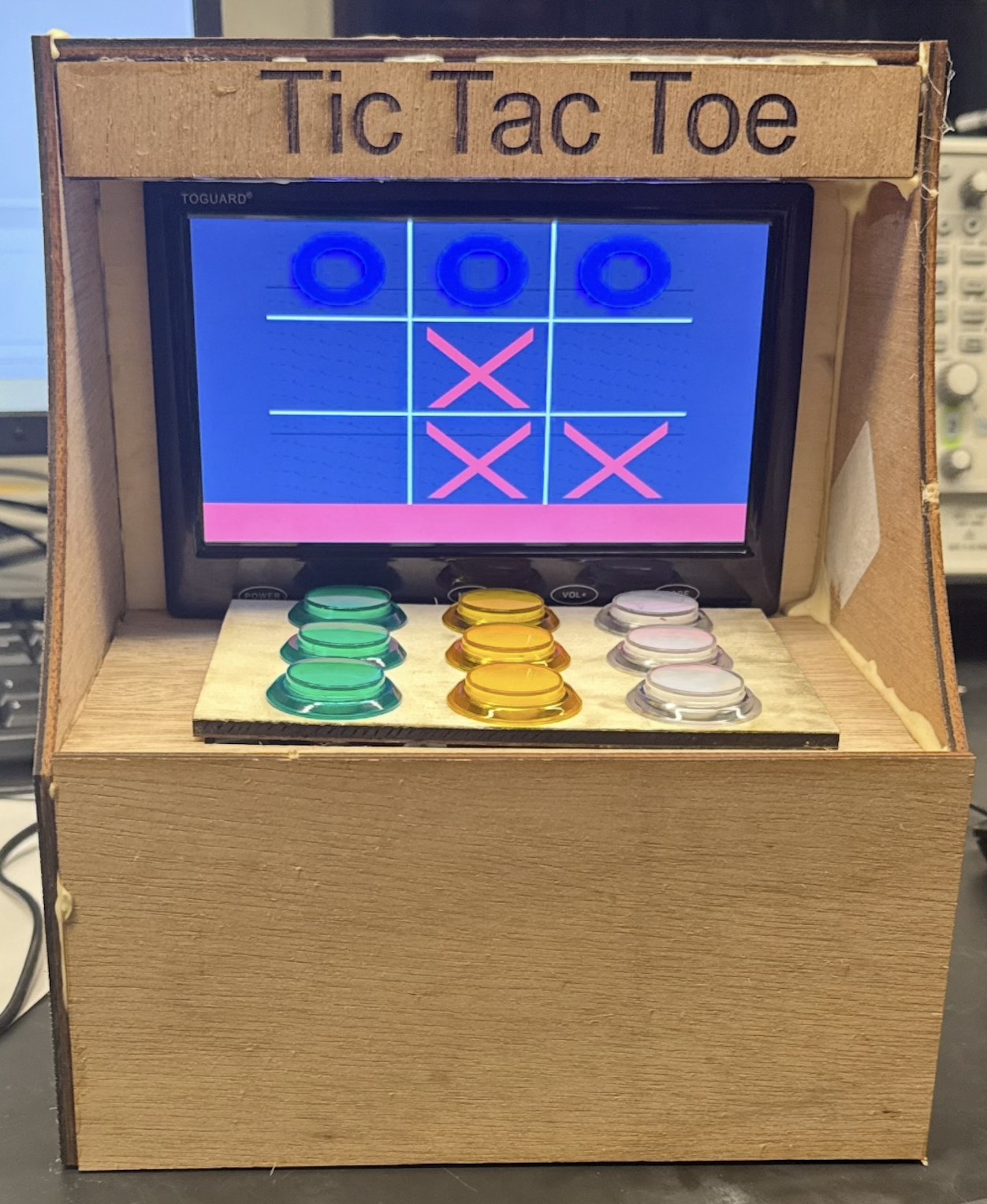
Tic-Tac-Toe arcade cabinet
Jan 2026 — Apr 2026

AI Tic-Tac-Toe on a Custom Processor

Human vs. minimax AI on an FPGA — custom 5-stage pipelined processor with custom instructions, physical button array, and VGA display.

FPGAHardwareDuke
HondaJetConfidential
May 2025 — Aug 2025

Automated Landing Gear Sensing System

A servo-driven system that automates weight-on-wheels sensing for Honda's flight test lab, replacing a slow, error-prone manual process.

AerospaceMechatronicsHonda
HondaJet EchelonConfidential
May 2025 — Aug 2025

Nose Wheel Steering Hardware Simulation

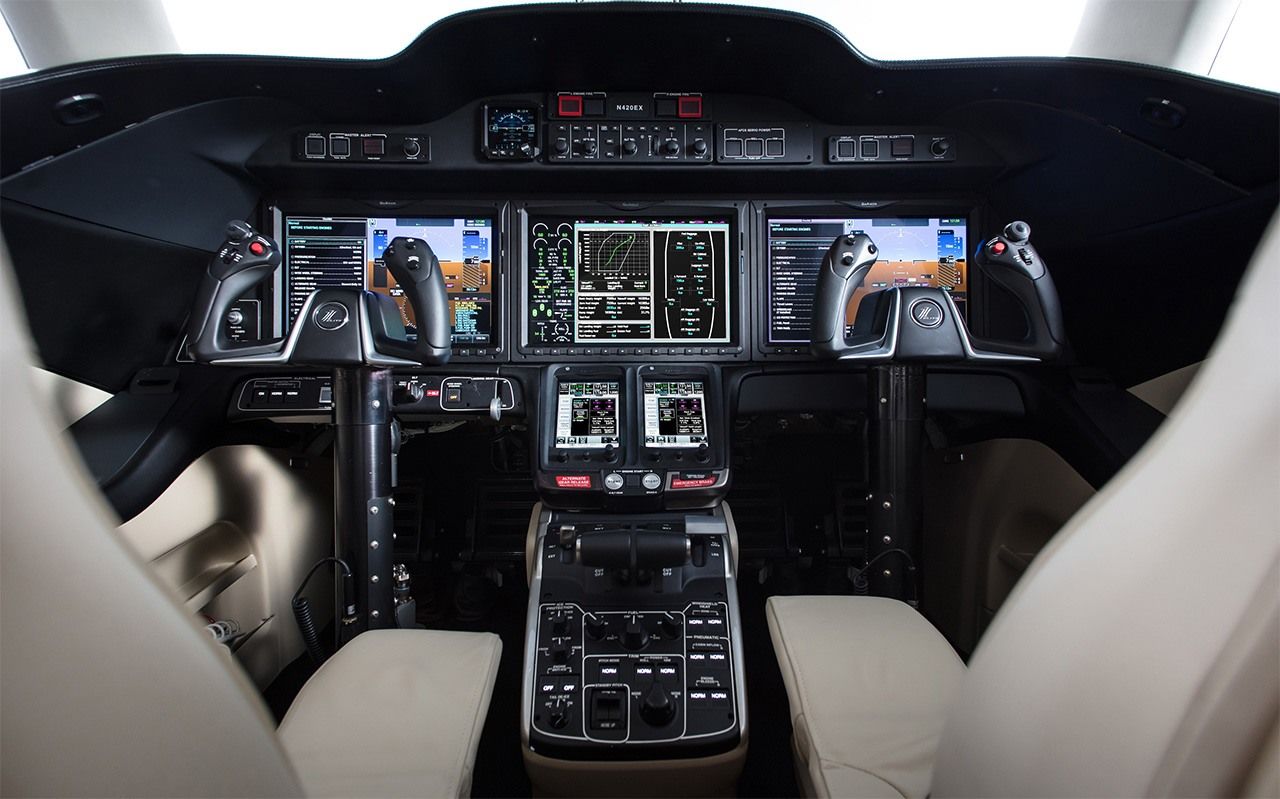
A hardware-in-the-loop test system replicating the nose wheel steering mechanism for Honda's Echelon aircraft — the first of its kind for the program.
AerospaceControlsHonda
HondaJet cockpitConfidential
May 2025 — Aug 2025

Cockpit Panel Design

Adapted and 3D-printed cockpit closeout panels for Honda's Echelon test facility — delivered on a $60K budget for $16.3K, saving roughly $43,700.
CAD3D PrintingHonda
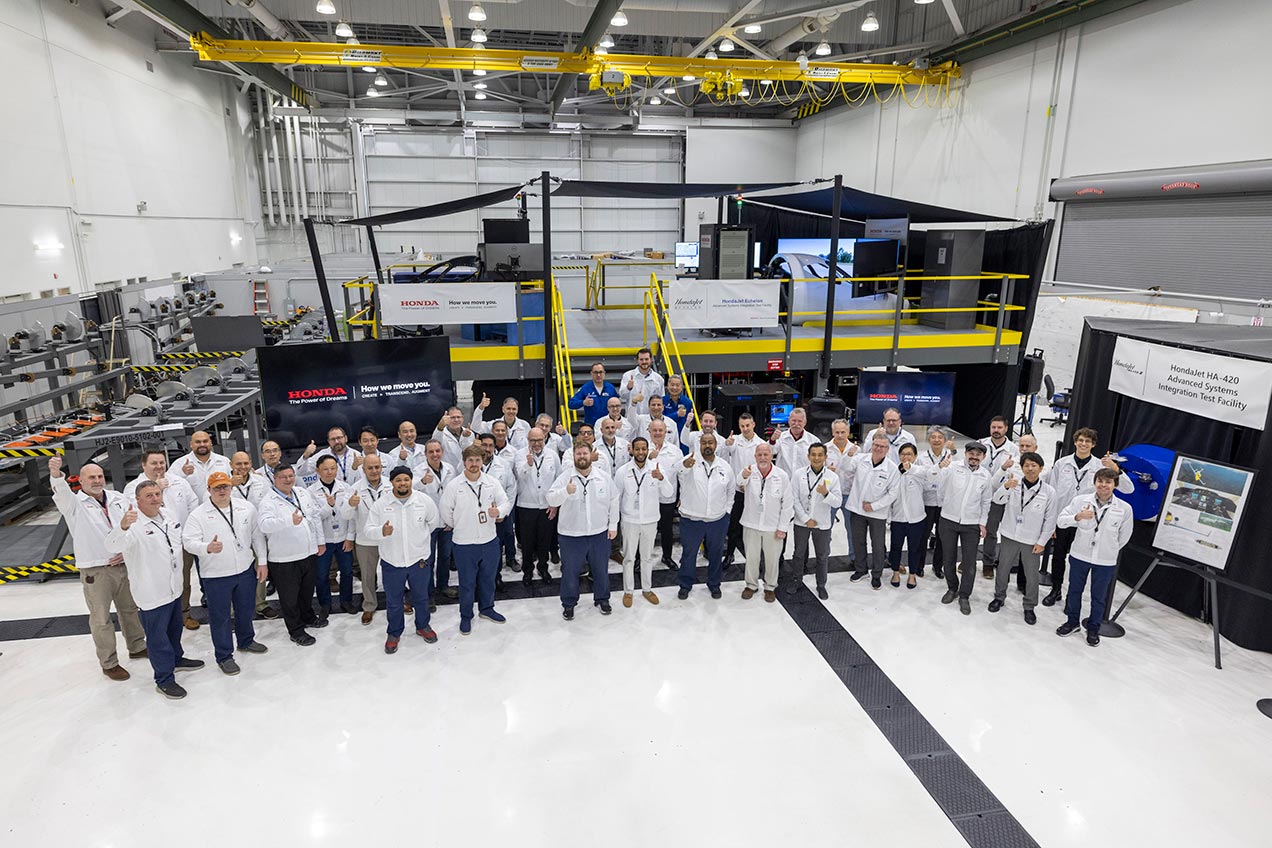
HondaJet integration test facilityConfidential
May 2025 — Aug 2025

External Lighting Visualization Panel

A physical testing panel that lets engineers and pilots see exactly how the aircraft's external lighting system behaves from inside the test cockpit.
ElectricalCADHonda
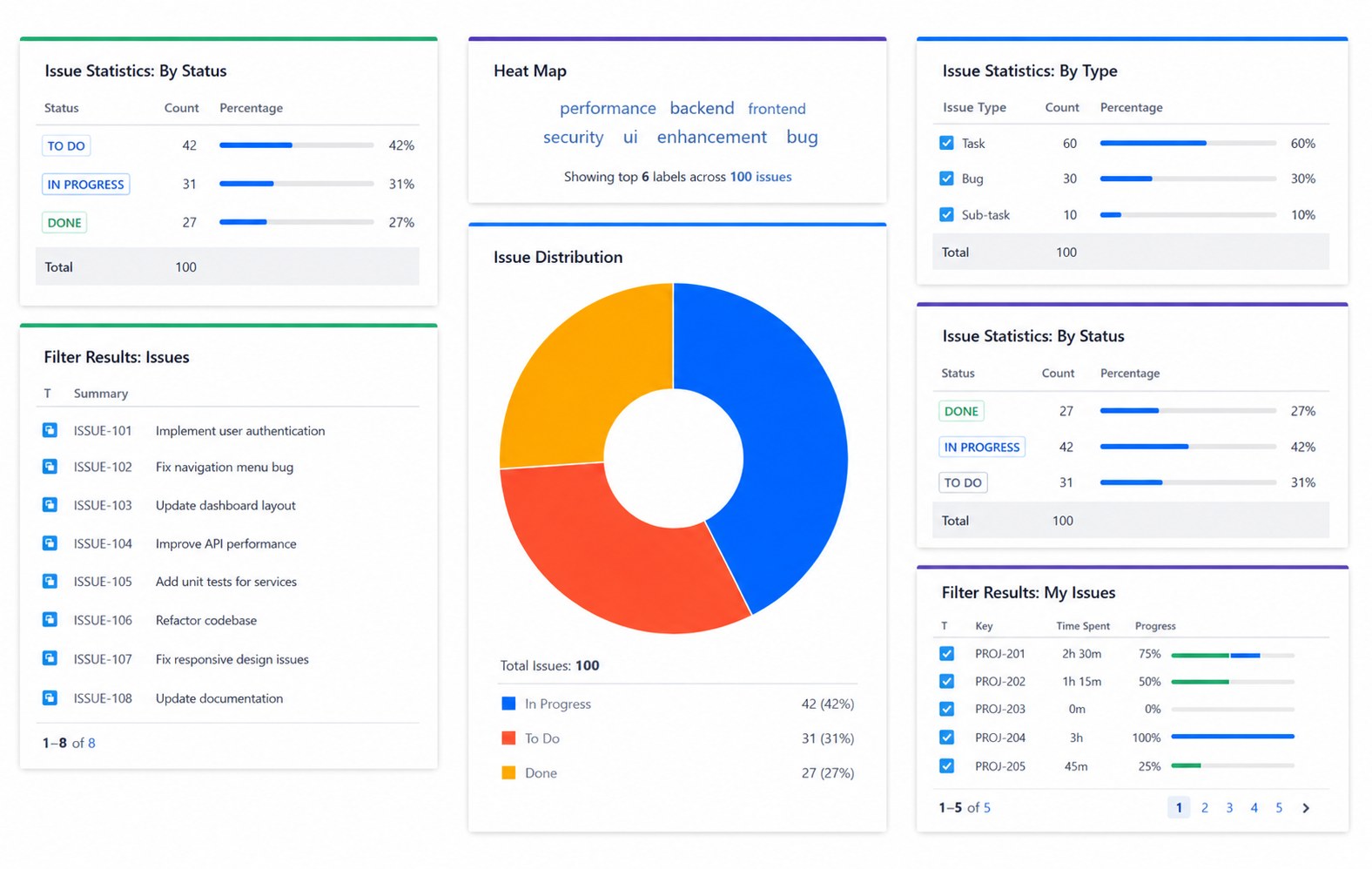
Jira issue dashboard
Jun 2024 — Aug 2024

Ticket Intake System Redesign & Dashboard

A ground-up rebuild of a client support intake system — conditional forms, automated routing, and real-time trend dashboards built in JQL.
SystemsAutomationJira
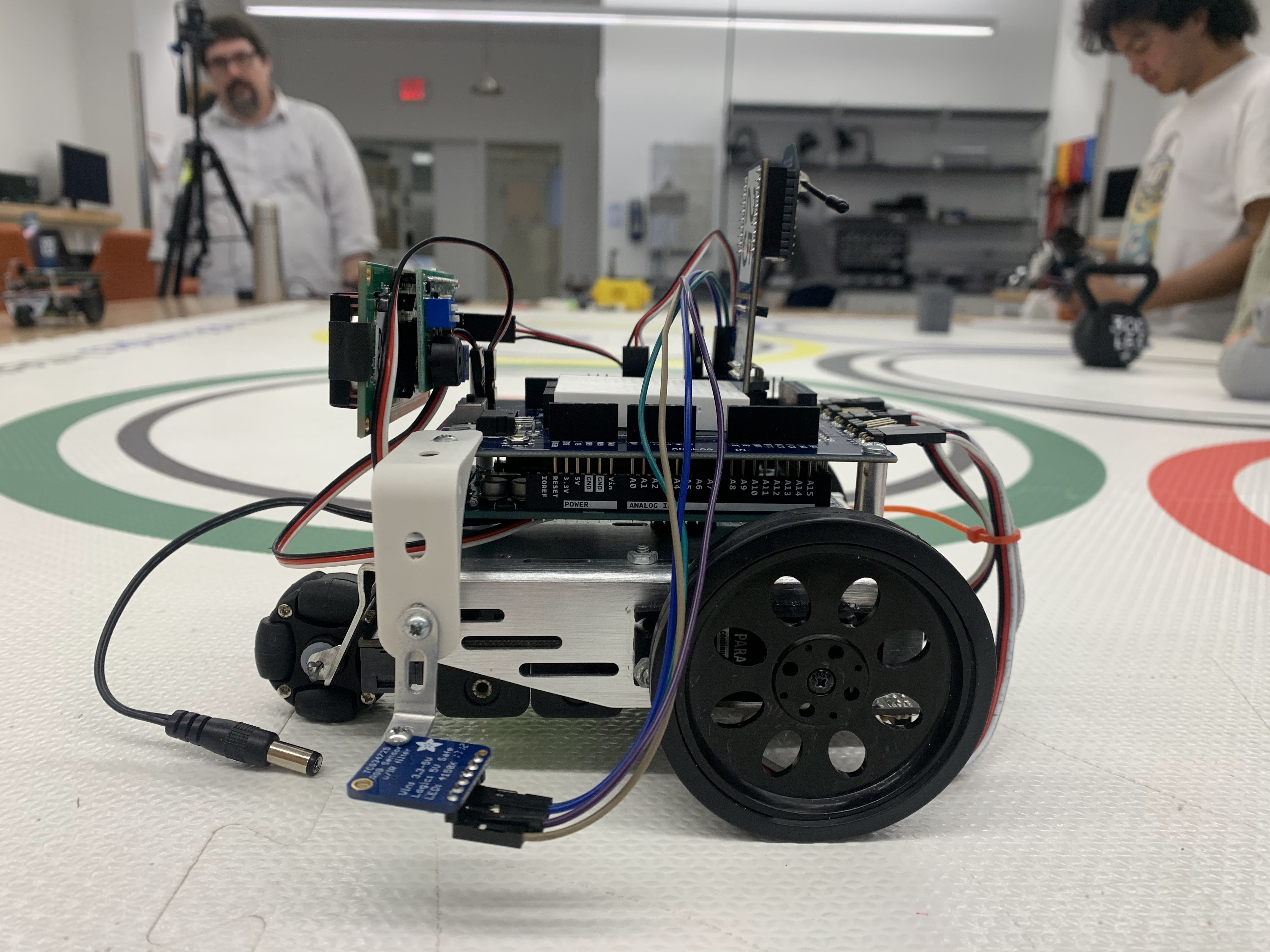
Multi-sensor autonomous robot
Feb 2024 — Apr 2024

Multi-Sensor Autonomous Bot

An Arduino-based robot that navigates, senses, and coordinates wirelessly with teammates to complete challenges without human input.
RoboticsC++Duke
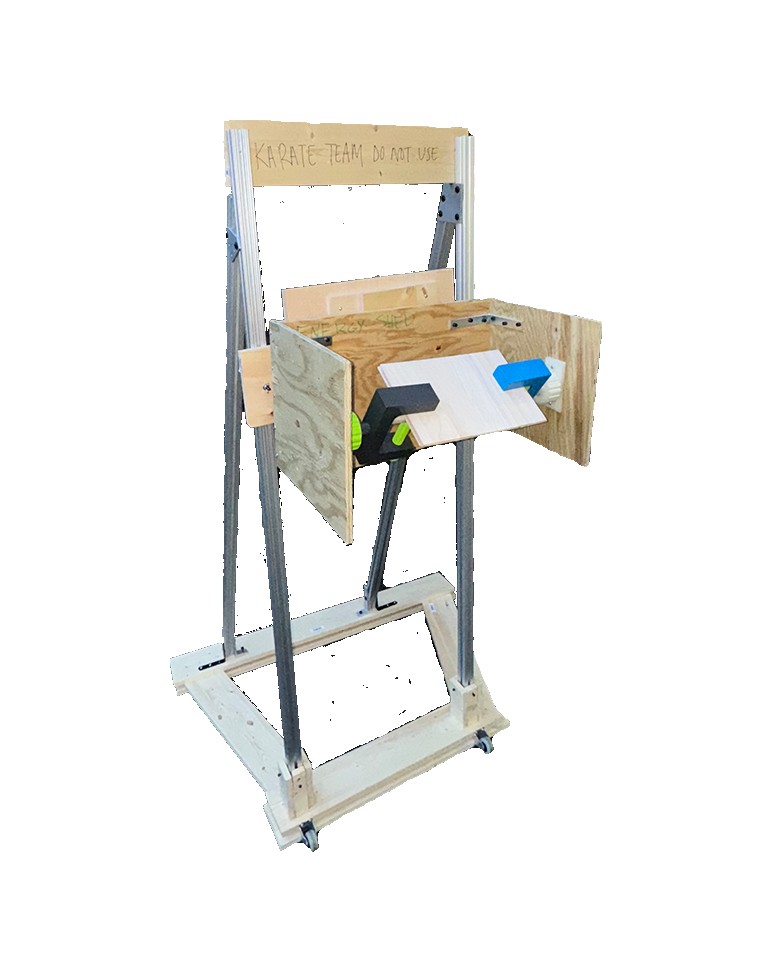
Free-standing karate board-breaking holder
Sep 2023 — Dec 2023

Free-Standing Karate Board-Breaking Holder

A client-commissioned device that safely holds breaking boards for karate students — no human bracing required.
MechanicalDesignDuke
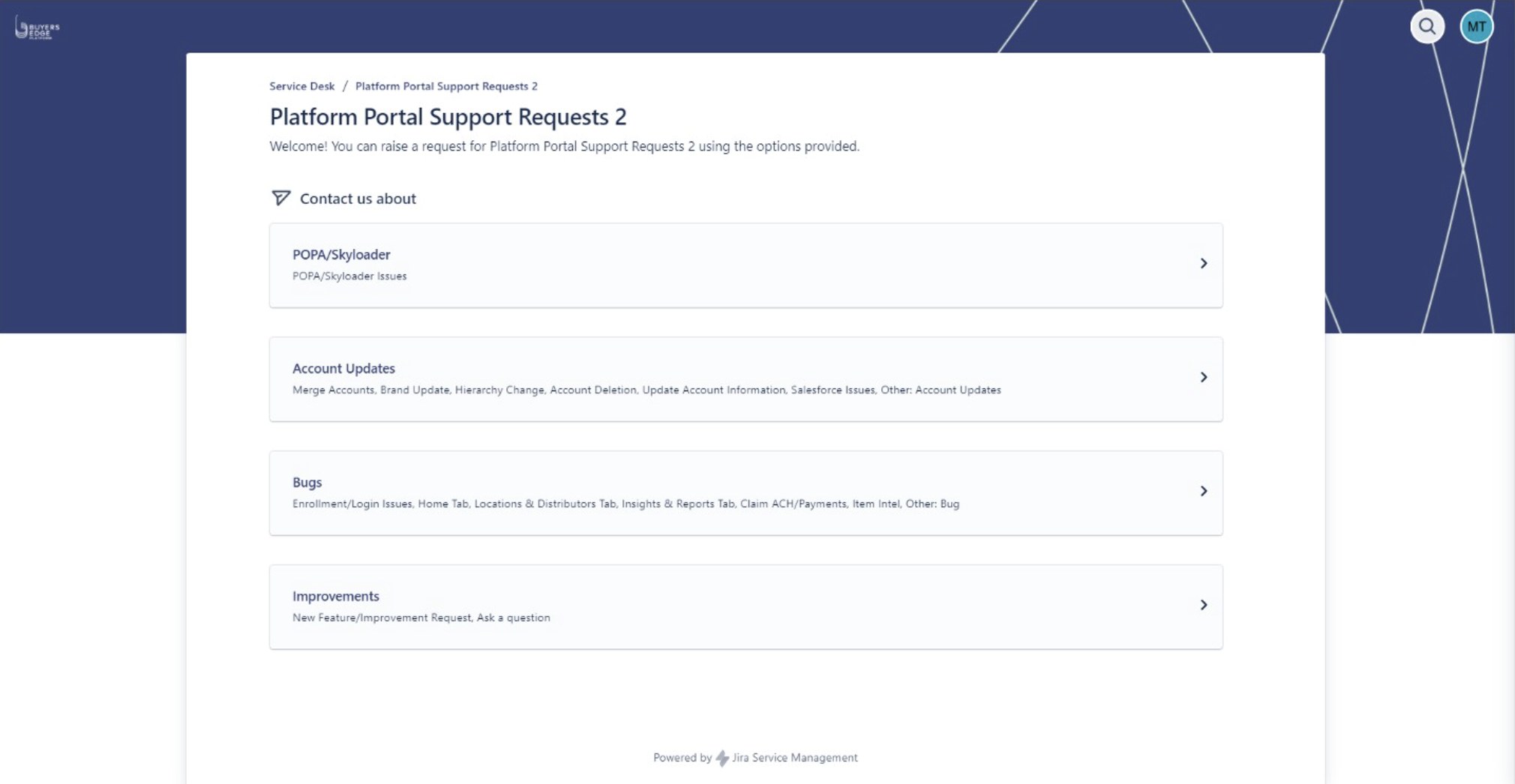
Support portal before and after redesign
Jun 2022 — Aug 2022

Automated Support Queue Workflow

Led a new Jira project that automatically routed internal support requests to the right owner — eliminating manual triage entirely.
AutomationJiraOperations

Let's connect.

← Back to all projects
AIInvestingSoftware

AI-Powered Investment Research Platform

Apr 2026 — Present

An AI research tool that automates early-stage deal screening and memo-writing for investors, with a focus on energy transition investing.

Multi-agent AI research pipeline diagram

The idea

Early-stage screening and diligence is repetitive, slow, and inconsistent — the same research steps run over and over for every company that crosses an investor's desk. I'm building a system that automates that pipeline end to end, so a firm can go from a company name to a structured, hypothesis-driven investment memo without the manual grind.

How it works

Rather than asking a single AI model to do everything, I architected a multi-agent system: a sequential pipeline of specialized components. One classifies each company by deal type (software, hardware, infrastructure, etc.), one runs rapid screening research, one performs deeper diligence pulling from sources like SEC filings and public financial data, and one synthesizes everything into a structured memo with a bull case, bear case, and base case. Each step feeds directly into the next, so the deeper research is guided by a specific hypothesis rather than being open-ended.

Design decisions

I made a deliberate choice to build the coordination between components directly on top of the underlying AI API rather than using a third-party agent framework — keeping the system transparent and easy to explain instead of hidden behind layers of abstraction. I've laid out the full technical architecture and data schema and am currently building the backend, starting with the deal-type classification component.

← Back to all projects
FPGAComputer ArchitectureDuke

AI Tic-Tac-Toe on a Custom Processor

Jan 2026 — Apr 2026 · ECE 350: Digital Systems, Duke University · with Andy Ko

Technical Report

A complete hardware–software system that realizes interactive Tic-Tac-Toe on an FPGA using a custom 5-stage pipelined processor — integrating physical button input, memory-mapped I/O, custom processor instructions, and VGA display output for real-time gameplay between a human and an AI opponent.

System architecture

The system has four primary components: a modified 5-stage pipelined processor that executes both standard and custom instructions, a memory subsystem storing board state and game variables, a physical input interface built from a 3×3 push-button array, and a VGA output system that renders the game in real time. The board lives in data memory addresses 0–8, with memory-mapped registers for input (address 4080 reports which button is pressed) and game status (address 4081 signals a human win, AI win, or draw) — keeping a clean interface between computation and visualization.

Custom instructions

To make board evaluation fast, we extended the processor with two custom R-type instructions. MOVEMASK converts the board state into a compact 9-bit player mask in a single instruction, eliminating the loops and branching that assembly would otherwise need. CHECKWIN takes that mask and evaluates all eight winning configurations in parallel using bitwise operations — constant-time win detection in one cycle. Both integrate into the execute stage using the pipeline's existing forwarding, stalling, and flush mechanisms, so no structural changes were required.

The AI

The AI opponent runs a no-depth-limit minimax algorithm written entirely in assembly: it recursively explores future game states, scoring +10 for an AI win, −10 for a human win, and 0 for a draw, simulating and undoing each candidate move. Because minimax is deeply recursive, correct stack management — saving return addresses and restoring values across nested calls — was essential. The result plays optimally; a human basically can't beat it.

Hardware

The input system is nine push buttons soldered onto a protoboard, each with a ~10 kΩ pull-down resistor to prevent floating inputs, with hot glue for strain relief and zip-tied wiring organized by button group. The VGA controller renders the grid and moves based on board memory. A key design fix: during minimax, intermediate board states were being drawn to the screen, making cells flash X's and O's mid-computation — we decoupled computation from display so only finalized moves render.

Testing

Testing ran iteratively across levels: processor and assembly verification in Vivado simulation (branches, function calls, stack behavior), independent validation of both custom instructions against all eight win patterns, per-button input testing, controlled VGA state checks, and full end-to-end gameplay. Full-system testing surfaced the display glitch and pipeline data hazards with the custom instructions, both resolved through forwarding verification, stall handling, and instruction sequencing.

← Back to all projects
AerospaceMechatronicsHonda

Automated Landing Gear Sensing System

May 2025 — Aug 2025 · Honda Flight Test Lab

An automated system that simulates weight-on-wheels sensing for hardware-in-the-loop testing — replacing a manual process where an engineer physically repositioned sensor covers to mimic the plane touching the ground.

The problem

The existing weight-on-wheels setup used proximity sensors with sliding covers: on the ground, a cover blocks the sensor; in the air, the sensor reads through a hole in the slider. To run a test, an engineer had to manually move the sliders into the correct orientation before the readings could feed the real-time simulation system — slow, and easy to get wrong.

Mechanical design

I replaced the manual process with a servo-driven mechanism of my own design, triggered automatically when the X-Plane flight simulator signals wheel touchdown. Converting the servos' rotational motion into the linear motion of the covers meant researching mechanism options independently — no mechanical engineer on the team could guide me — and settling on a slider-crank system. I taught myself CATIA from scratch to model the full assembly with proper functional design and tolerancing, then ordered the hardware and built the complete sheet-metal model.

Electrical design

I controlled the servos with 5V PWM signals from an Arduino, powered all four from an external 5V supply, and used 28V-to-5V DC-DC converters to step the aircraft's 28V signals (from a UEI DNR-433 card) down to a range the Arduino could safely read. I soldered the electronics into a project box, wired the full system, and documented the electrical architecture in Visio for lab implementation.

Impact

The system fully automates weight-on-wheels stimulation, giving the lab hardware-in-the-loop and software-in-the-loop integration testing capability it didn't have before.

← Back to all projects
AerospaceControlsHonda

Nose Wheel Steering Hardware Simulation

May 2025 — Aug 2025 · Honda Flight Test Lab

A hardware-in-the-loop system replicating the hydraulically controlled nose wheel steering mechanism for Honda's Echelon aircraft — a test capability that didn't exist on the prior model.

The problem

The position of a steering control valve actuator's LVDT rod determines the nose wheel steering angle. To test the system without the aircraft, I needed a linear actuator to drive that rod — but the actuator I had moved too slowly for the real-time simulation system to faithfully mimic the real hardware.

Mechanical design

I designed a lever-and-fulcrum mechanism in CATIA that doubled the actuator's effective speed: a clevis joint as the fulcrum, with the effort arm half the length of the load arm. I designed rod ends and clevis joints to translate forces cleanly between the actuator and LVDT rod, plus custom clamps to secure everything to the lab's test rack — then 3D printed all of it.

Electrical & controls

The actuator ran on 12V with direction controlled by polarity, so I used a DPDT switch for direction and an SPDT switch for power, both driven by a Pickering 40-584 switch matrix card applying 28V to the coils. I added a linear potentiometer to read rod position, charted its voltage-position relationship, and routed the signal through a dSPACE card. Finally, I built a feedback control loop in Simulink with a PID controller to manage movement and correct for overshoot, and documented the full electrical design for lab implementation.

Impact

The system gave the team its first hardware-in-the-loop test capability for nose wheel steering on the Echelon — a larger, more complex aircraft than the original model — enabling testing of individual parts and the full steering system.

← Back to all projects
CAD3D PrintingHonda

Cockpit Panel Design

May 2025 — Aug 2025 · Honda Flight Test Lab

Adapting cockpit closeout panels for an aircraft that wasn't in production yet — and delivering a $60,000 project for $16,327.53.

Overview

The facility's operations manager asked me to take this on after noticing my CATIA work on other projects. The newer Echelon aircraft's cockpit wasn't in production yet, so its interior closeout panels had to be adapted to fit the older aircraft frame used in the test facility.

What I did

I used a range of CATIA methods to parse, solidify, and join the design files — cleaning them up so they could be printed efficiently and within the constraints of the lab's available 3D printer.

Impact

The project had a $60,000 budget. I completed it for $16,327.53, saving roughly $43,700.

← Back to all projects
ElectricalCADHonda

External Lighting Visualization Panel

May 2025 — Aug 2025 · Honda Flight Test Lab

A physical testing panel that gives engineers and pilots a hands-on reference for how the aircraft's external lighting system actually behaves.

Overview

I designed and built a testing panel to visualize the aircraft's external lighting system — including the physical enclosure, light mounts, and connector cutouts, drilling and cutting the D-sub openings myself.

What I built

I first simplified the original electrical design down to exactly which lights were needed, what signals drove each one, and how they mapped to D-sub connectors — cutting unnecessary complexity out of the wiring. Then I used CATIA's Aerospace Sheet Metal Design tools to create custom clamps mounting the lights on the railings visible from inside the Echelon test facility cockpit.

Impact

Engineers and pilots in the test facility can now see the lighting system respond in real time, instead of reasoning about it from electrical drawings.

← Back to all projects
SystemsAutomationJira

Ticket Intake System Redesign & Dashboard

Jun 2024 — Aug 2024

A ground-up rebuild of a client support intake system used by restaurant account managers — turning four vague request categories into a structured, self-routing system with real-time trend dashboards.

Jira issue dashboard

The problem

Managing the support request queue day-to-day, I saw the same failure repeatedly: the intake form had only four broad request types, so tickets arrived vague, mis-categorized, and missing the information needed to solve them. Every ticket meant back-and-forth with the requestor and manual detective work across portal dashboards, Salesforce, and internal databases. I also helped work down a 170-ticket bug backlog, resolving about a third of the tickets myself.

The redesign

I rebuilt the intake form from the ground up with specific request types — account merges, brand updates, hierarchy changes, deletions, and categorized bug reports by product area — each backed by a Jira form with conditional logic that prompts the requestor for exactly the information needed to solve that issue. The goal: tickets arrive pre-categorized and complete, eliminating most requestor follow-up. I layered in automations that auto-assign each request type to the right owner and keep categorization fields consistent for reporting.

The dashboard

Jira doesn't filter well by request type, so I designed a workaround: hidden fields with default values per request type that filters could key on. Using JQL, I built dashboards tracking ticket trends by type and by day, so the QA team could spot recurring issues and act proactively instead of reactively. I also re-categorized the historical backlog so the trend data was accurate from day one.

Making it stick

I gathered feedback from the account managers using the new form and shipped quick fixes, then wrote a step-by-step SOP documenting how to build and maintain future request types, forms, automations, filters, and dashboards — so the system could scale without me.

← Back to all projects
RoboticsC++Duke

Multi-Sensor Autonomous Bot

Feb 2024 — Apr 2024 · Duke University

An Arduino-based autonomous robot that navigates, senses its environment through six different sensor types, and coordinates wirelessly with teammate robots in real time.

Multi-sensor autonomous robot

Overview

I developed and programmed the bot on an Arduino in C++ to autonomously complete a series of challenges without human input — path navigation, environmental sensing, object identification, and team-based coordination tasks.

Navigation & sensing

QTI sensors handled line-following for path navigation, while PING))) ultrasonic sensors measured distances to detect obstacles. A thermal IR sensor measured temperature, an RGB color sensor identified objects by color, and a Hall Effect sensor detected magnetic polarity — giving the bot a full picture of its environment across five different sensing modalities.

Identification & feedback

An integrated RFID reader scanned tags for identification tasks, an onboard LED signaled status updates, and a 4×20 LCD display output sensor readings and state in real time — so the bot's decision-making was visible as it worked.

Team coordination

For team-based challenges, XBee wireless modules enabled communication and coordination with other bots — sharing state and dividing up tasks in real time as each challenge unfolded.

← Back to all projects
MechanicalDesignDuke

Free-Standing Karate Board-Breaking Holder

Sep 2023 — Dec 2023 · Duke University

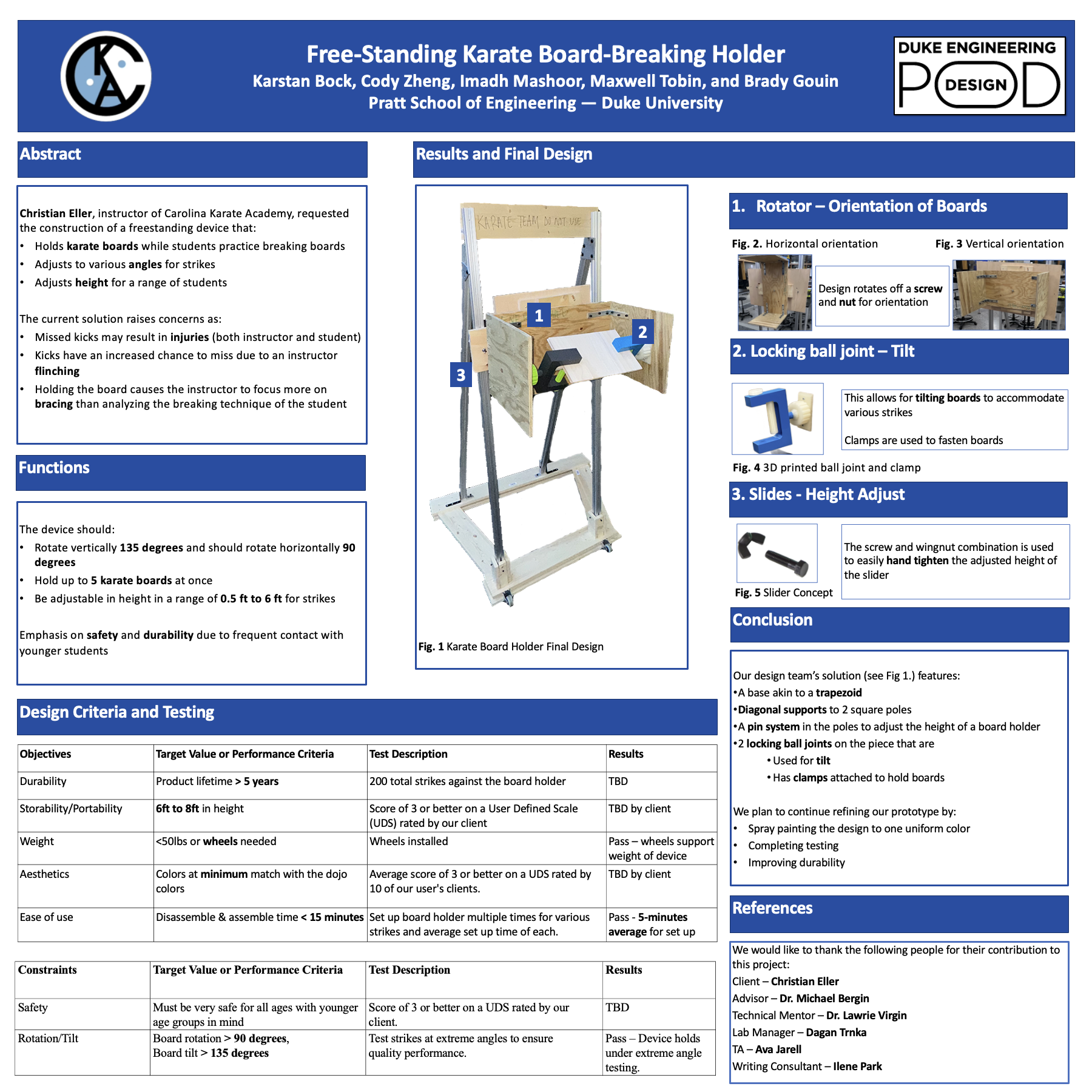
A client-commissioned device that holds breaking boards during student strikes — removing the injury risk of an instructor bracing boards by hand.

Free-standing karate board-breaking holder

The client

A local karate academy instructor needed a way to hold breaking boards during student strikes without physically bracing them himself. His original method created injury risk for both students and himself, and pulled his focus away from coaching technique.

What I did

Working on a 5-person engineering design team, I led testing and validation against our design specifications — running repeated strikes to confirm the device handled over 90 degrees of horizontal rotation and 135 degrees of tilt under real impact, and timing assembly and disassembly to validate our under-5-minute setup target. I also contributed key mechanical elements, including the locking ball joint that lets boards tilt to match different strike angles, and worked with teammates on the height-adjustable slider accommodating students from 0.5 to 6 feet.

Outcome

A free-standing device the instructor can set up in minutes, letting him coach technique while the hardware takes the hits.

← Back to all projects
AutomationJiraOperations

Automated Support Queue Workflow

Jun 2022 — Aug 2022

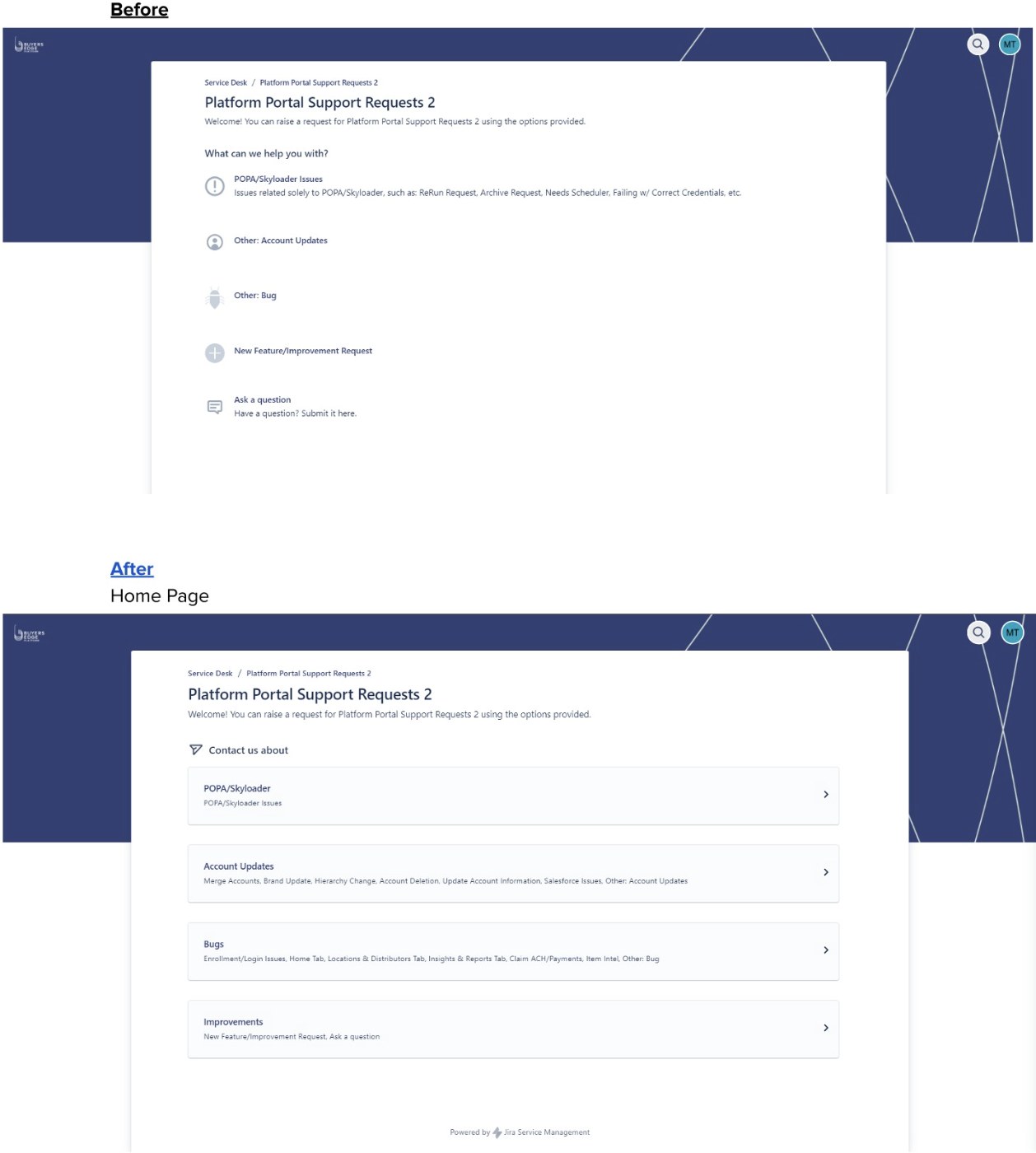
A new Jira project — which I built and led — that automatically routed internal support requests to the person who could actually solve them, eliminating manual triage.

Redesigned support portal home page

The problem

Before this, every incoming ticket required someone to manually figure out what the problem was, chase down details from the requestor, and hand it to the right person. My job was diagnosing those issues — which meant learning the company's data model (purchase agreements, distributor and merchant identifiers, portal databases) and cross-referencing records across databases to find duplicate accounts, misaligned data, and bugs.

What I built

I created and led a new, improved Jira project with automations that classified incoming issue types and routed each one directly to the correct owner, with the information needed to solve it attached. This eliminated manual input and cut resolution time across the product development team's internal queue.

Also that summer

I authored a company-wide SOP for expense reporting and managed expense reports for key executives.